
Agile Hardware Development: What Works, What Doesn't, and Why
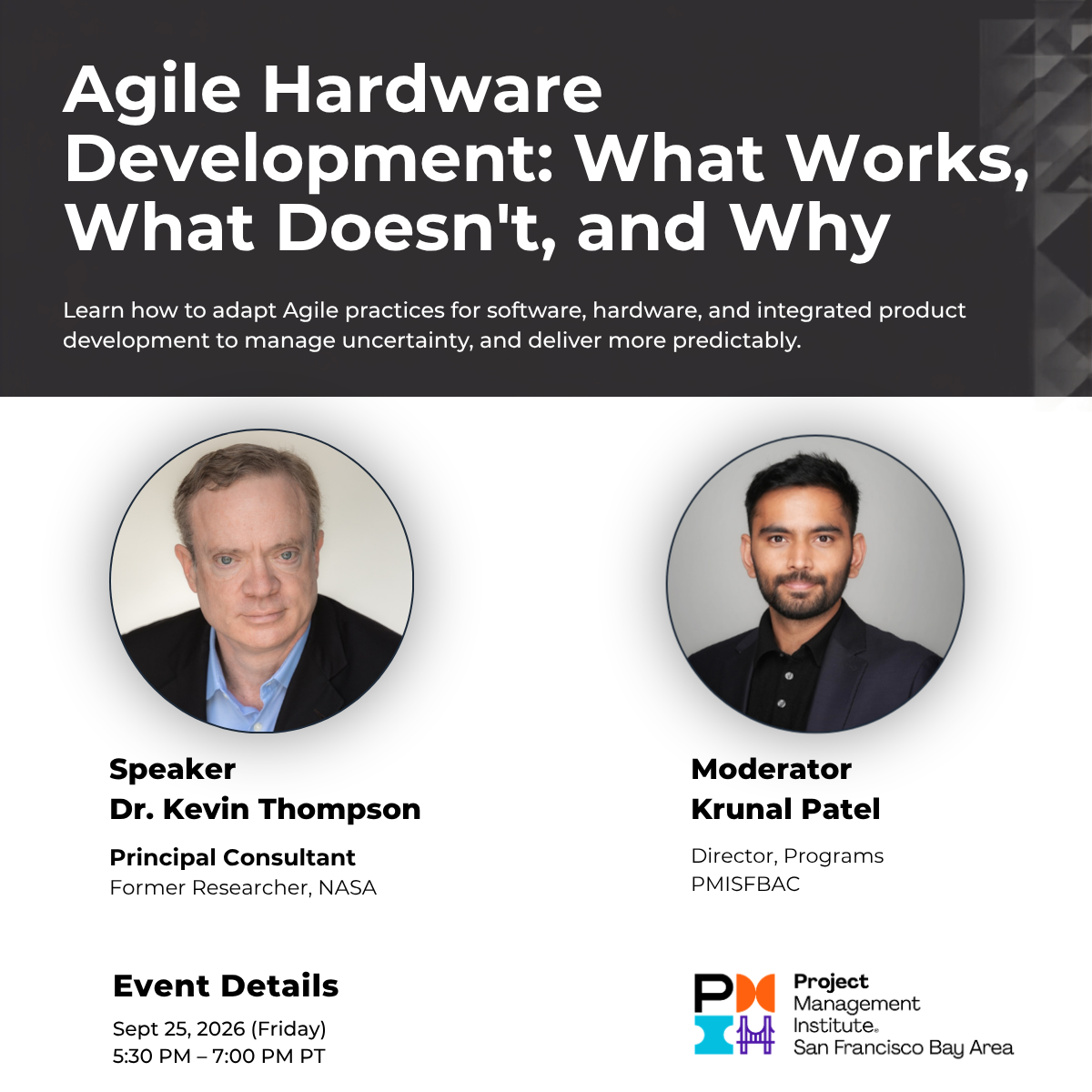
Agile Hardware Development: What Works, What Doesn't, and Why
Presented by Dr. Kevin Thompson | Moderated by Krunal Patel
Earn 1.5 PDUs (Ways of Working)
Agile transformed software. Applied straight to hardware, it usually frustrates everyone involved.
Physical products run on different rules: long lead times, tooling investments, manufacturing constraints, expensive late changes, and designs that mature in stages. Most organizations still run hardware programs on practices built for software, then wonder why the sprints feel artificial and the schedule still slips.
Dr. Kevin Thompson has led more than 100 Agile transformations, including complex hardware, embedded systems, and combined hardware and software programs. He shows what to keep, what to rework, and what actually improves predictability on physical products.
What You Will Learn
- Why "software Scrum with longer lead times" fails on hardware.
- Which Agile principles transfer as is, and which practices need rework.
- How to build Sprints around engineering deliverables and uncertainty reduction.
- How release planning, technical stories, and progressive elaboration improve predictability.
- How to cut late surprises, integration risk, and costly redesigns.
You will leave with a practical, proven way to apply Agile to physical products.
About the Speaker
Dr. Kevin Thompson is Principal Consultant at Kevin Thompson Ph.D. Consulting, specializing in Agile hardware development, Scrum at scale, and Agile transformation. A physicist by training (B.S. Santa Clara, Ph.D. Princeton) who researched at Lawrence Livermore and NASA Ames, he moved into software engineering and project management, and as PMO Manager at StarCite led the Scrum adoption that finally shipped a long delayed product. He holds the PMP, CSM, and CSP certifications.
Website: https://kevinthompsonphd.com/about-kevin-thompson
Moderator: Krunal Patel, Senior Technical Program Manager in semiconductors, Director of Programs at PMI San Francisco Bay Area Chapter, and a published researcher on Agile for hardware.
This session qualifies for 1.5 PDUs toward your PMI certification maintenance.
General Events Refund & Cancellation Policy
Paid Events
Registrations for paid events are non-refundable once completed unless explicitly mentioned on the event card above. We encourage participants to confirm availability prior to registering.
If the Chapter cancels or reschedules a paid event, registered participants will be notified and provided with available options, which may include a refund or transfer at the Chapter’s discretion.
Participants who do not attend a registered paid event (“no-shows”) are not eligible for a refund, credit, or transfer.
Free Events
We understand that plans may change. If you are unable to attend a free event, we kindly ask that you cancel your registration in advance whenever possible. This allows others the opportunity to participate and helps our volunteers plan more effectively.